Choosing the right mechanical switch for gaming is a complex decision that directly impacts your competitive performance.
In 2026, the market has moved beyond the simple “Red, Brown, Blue” categorization to offer switches specifically engineered for response time and actuation precision.
While aesthetic preferences matter, the technical performance of a gaming switch is defined by its force curve consistency and its input latency.
The challenge for a competitive gamer is not finding a fast switch, but finding a switch that balances raw speed with input accuracy to minimize accidental keypresses.
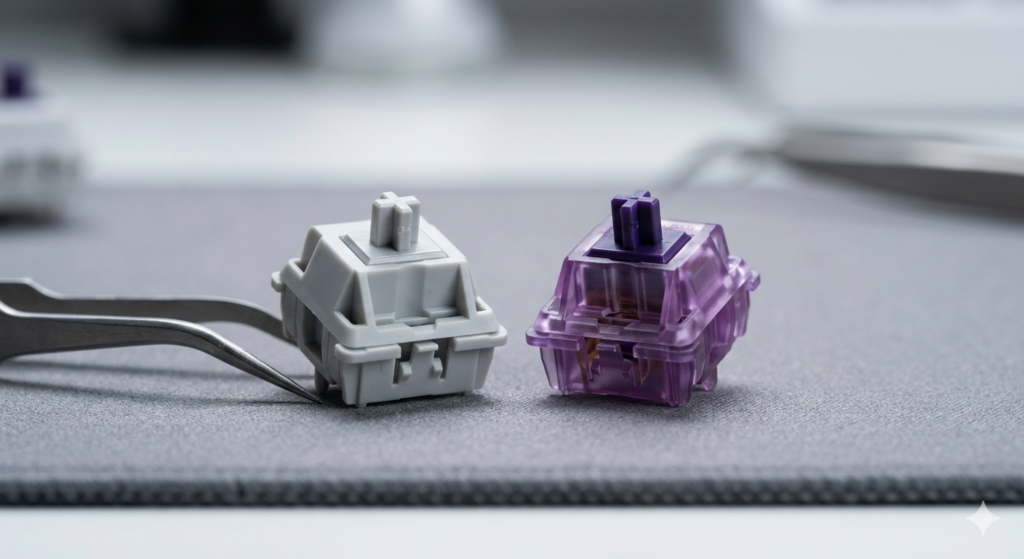
This guide provides a professional, technical analysis of the two dominant gaming switch philosophies: Speed (Linear) and Accuracy (Tactile).
Technical Criteria for Gaming Performance
To compare gaming switches, we must analyze the physics of the keystroke.
We evaluate gaming switches based on four specific metrics:
- Actuation Distance: The exact distance the stem must travel vertically before the internal copper leaves make contact and register the keypress. Standard switches actuate at 2.0mm, while “Speed” switches actuate much higher, often at 1.0mm to 1.2mm.
- Actuation Force (Operating Force): The specific amount of pressure, measured in grams (g) or centinewtons (cN), required to reach that actuation point.
- Total Travel Distance: The maximum vertical distance the stem can move before it “bottoms out” against the switch housing.
- Force Curve Consistency: How smoothly the required force increases during the press. A jerky or inconsistent force curve can interfere with rapid inputs.
Read Also: The Ultimate Guide to Keycap Legends
Speed Switches: Minimal Latency for Rapid Input
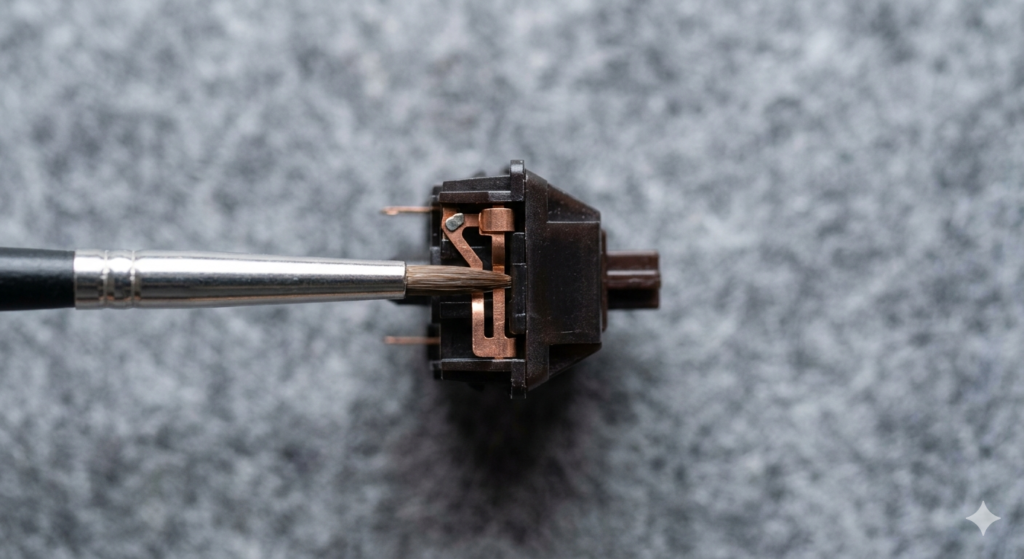
The primary philosophy behind “Speed” switches is reducing physical input latency.
These are almost always linear switches, meaning there is no tactile “bump” or audible click during the press.
Technical Analysis: Speed switches, such as the silver stem linear example shown side-by-side, utilize a shorter internal stem and a modified copper leaf structure.
This design reduces the actuation distance by up to 50% compared to a standard switch.
The recursive benefit is that the time between your brain deciding to press the key and the computer registering the input is minimized.
This is critical for genres requiring rapid, repetitive inputs, such as First-Person Shooters (FPS) and Real-Time Strategy (RTS) games.
The Compromise: Accidental Actuation
The major trade-off for raw speed is reduced accuracy.
Because the actuation point is so high, extremely light pressure—even just resting your fingers heavily on the keycaps—can cause unintended inputs.
This can lead to devastating errors in competitive play, such as accidentally deploying an ability (a “fat-finger” error) at the wrong moment.
Gaming on ultra-light speed switches (matching the measurements shown under full compression) requires exceptional discipline and finger control.
Read Also: Optimizing the Switch Stem Rail and Pole
Accuracy Switches: Tactile Feedback for Precision Control
The “Accuracy” philosophy prioritizes input precision over absolute latency reduction.
These switches often utilize light-to-medium tactile feedback.
Technical Analysis: Accuracy switches (like the translucent purple example shown in the comparison) retain a standard 2.0mm or slightly reduced 1.8mm actuation distance.
They incorporate a distinct “bump” in the force curve before the actuation point.
Your finger must apply slightly more force to overcome this bump, ensuring that every keypress is a deliberate, conscious action.
This feedback provides a massive advantage in tactical shooters (like Valorant or Counter-Strike) and MOBA titles, where accidental inputs can lose rounds.
Advanced Performance: Hall Effect and Rapid Trigger
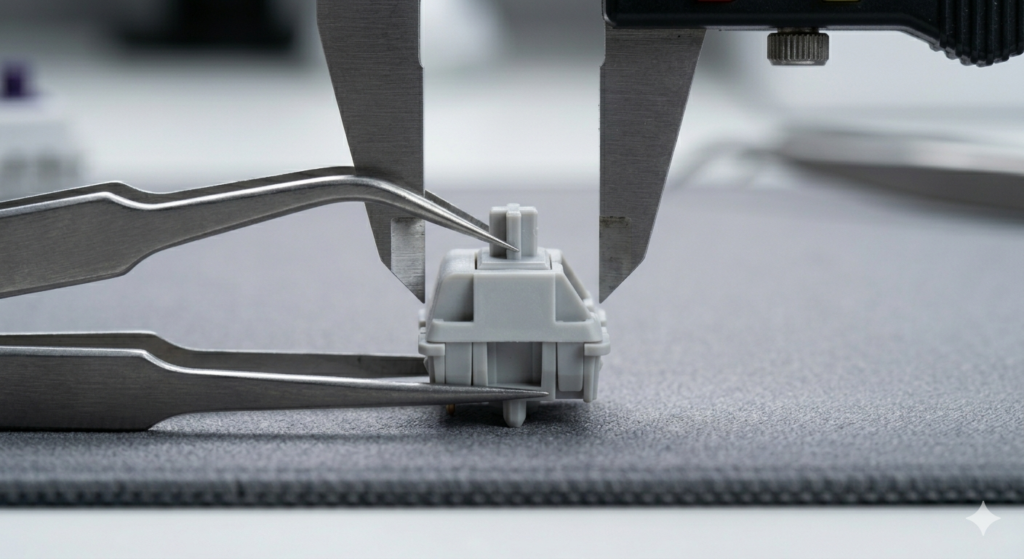
The absolute cutting edge of gaming switch technology in 2026 is the adoption of Hall Effect (Magnetic) sensing.
Unlike traditional mechanical switches that rely on physical contact between copper leaves, Hall Effect switches use magnets to measure the stem’s exact position.
This design provides two transformative technical advantages.
First, the actuation point is fully adjustable in software, from an ultra-fast 0.1mm to a deep 4.0mm.
Second, they enable “Rapid Trigger” technology. A traditional switch must travel back past a reset point before it can actuate again. A Rapid Trigger switch resets instantly the moment your finger begins to lift, allowing for faster repetitive inputs than any physical copper contact can achieve.
Optimization: Lubrication for Consistency
Regardless of the sensing method, the consistency of the force curve is critical.
This is why many professional gaming switches are meticulously lubricated from the factory or by the user (matching the technical procedure demonstrated).
Lubrication eliminates minor plastic-on-plastic friction, ensuring that the force curve is perfectly smooth.
A smoother press reduces input variance and provides a more consistent, predictable feel, which is foundational for muscle memory development.
Conclusion
Selecting the right gaming switch is the logical recursion of professional performance tuning.
Raw speed (exemplified by the linear short-travel switches) offers a distinct advantage in rapid-fire scenarios, but demands high finger discipline.
Accuracy switches provide critical tactile feedback for precision control, virtually eliminating accidental inputs.
The future lies in Hall Effect technology, which offers the ultimate recursion: combining adjustable speed with the consistency required for accuracy.
Execute your assembly cleanly, optimize the movement, and choose the hardware that matches your competitive requirements.